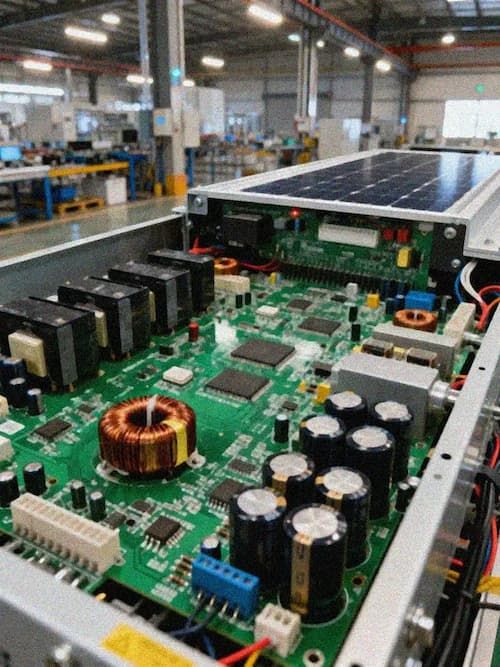
Overview
As one of the fastest-growing renewable energy sources, wind power generation systems operate in extremely harsh environments, including high-altitude onshore wind farms with wide temperature fluctuations, offshore sites with continuous salt spray and high humidity, and mountainous regions with frequent vibration shocks. Wind turbine systems require a 25+ year service life, placing extremely stringent requirements on PCB reliability, power handling capacity, thermal performance, and signal stability. Wind energy PCB solutions cover the full process from design optimization, material selection, manufacturing, to multi-stage reliability testing, addressing core industry pain points such as high-voltage and high-current transmission stability, electromagnetic interference resistance, and long-term environmental adaptability, meeting the performance needs of all core wind power subsystems.
Technical Capabilities
- Diverse Board Type Support: Covers single and double-sided boards, 2-32 layer multilayer boards, heavy copper boards for high-power transmission, high-frequency hybrid boards for communication systems, metal core/metal substrate boards for high heat dissipation scenarios, rigid-flex boards for compact nacelle installations, buried copper block and buried ceramic boards for enhanced thermal management, and high-resistance carbon oil boards for control circuits, adapting to the diverse functional requirements of different wind power subsystems.
- High-Precision Manufacturing Specifications: Supports minimum pitch accuracy of 0.5, and ultra-small component packages as small as 01005 (0.3mm*0.2mm) for high-density control circuit designs. Maximum board production size reaches 600mm x 450mm, adapting to large-format power conversion board requirements, with support for component thickness ranging from less than 0.5mm to more than 3mm, and double-sided assembly component height up to 25mm, meeting the assembly needs of both compact sensing modules and large power components.
- Optimized Power and Signal Performance: Supports high-voltage DC and AC power interface designs, as well as common control signal interfaces including I2C, TDM, and PCM, with ±5% high-precision impedance control to ensure stable signal transmission between sensing, control, and communication modules, reducing signal attenuation and crosstalk in the high-electromagnetic interference environment inside wind turbine nacelles.
- Customized Structural Design Optimization: Provides targeted structural design services including material matching, process adjustment, mold opening optimization, reinforcement design, and protective coating design, enhancing the board's resistance to vibration, corrosion, and moisture, with custom solutions developed for special scenarios such as offshore subsea control units and high-altitude cold region wind farms.
Quality Standards
All wind energy PCB products adhere to international and industry-specific quality standards, with full traceability for all raw materials and production processes. Every batch of products undergoes strict multi-stage testing before delivery, including:
- Functional testing, impedance testing, and insulation resistance testing to ensure electrical performance meets design requirements
- Thermal cycling testing covering -40℃ to +125℃ for 1000+ cycles, verifying stability under extreme temperature fluctuations
- Vibration and shock testing up to 20G acceleration, simulating the long-term vibration environment of operating wind turbines
- 1000+ hour salt spray testing for offshore application products, verifying corrosion resistance
- EMC testing compliant with IEC 61000 standards, ensuring resistance to electromagnetic interference in complex grid environments
Manufacturing processes are aligned with ISO 9001, ISO 14001, IEC 61400, and RoHS/REACH environmental requirements, ensuring product service life matches the 25+ year design life of wind turbine systems, reducing long-term operation and maintenance costs for wind farm operators.
Applications
Wind energy PCB solutions are widely applicable to all core subsystems of onshore, offshore, and distributed wind power projects, including:
- Wind Turbine Power Conversion Systems: Including AC/DC converters, grid-tie inverters, and reactive power compensation modules, using heavy copper and metal core PCBs to handle high current loads, with excellent heat dissipation performance to ensure stable power conversion efficiency.
- Nacelle Control Systems: Including pitch control units, yaw control systems, and main turbine controllers, using high-reliability multilayer, rigid-flex, or buried copper block PCBs to resist continuous vibration and wide temperature changes, ensuring accurate transmission of control signals.
- Condition Monitoring Systems: Including vibration sensors, temperature monitoring modules, and edge data acquisition units, using HDI and high-frequency PCBs to support high-speed data transmission, enabling real-time monitoring of turbine operating status and predictive maintenance.
- Offshore Wind Farm Subsea Control Units: Using corrosion-resistant, high-insulation PCB configurations with special anti-salt spray protective coatings, adapting to high humidity, high water pressure, and salt spray erosion environments for long-term stable operation.
- Wind Energy Storage Supporting Systems: Including battery management systems (BMS) and energy storage converters, using high-current heavy copper PCBs to support efficient charge and discharge management, improving the grid compatibility of wind power systems.
- Wind Farm SCADA and Communication Systems: Using high-frequency hybrid PCBs to support long-distance wired and wireless communication between individual turbines and central control centers, ensuring real-time data transmission and remote control capabilities.
Key Advantages
- Extreme Environment Adaptability: All PCB products are optimized for harsh wind farm operating conditions, supporting stable operation in temperature ranges from -40℃ to +125℃, with high resistance to vibration, shock, salt spray, and humidity, fully adapting to onshore, offshore, high-altitude, and cold region application scenarios.
- High Power Handling Performance: Supports heavy copper board manufacturing with up to 20oz copper thickness, as well as metal core and buried copper block board configurations, effectively reducing thermal resistance and voltage drop, adapting to the high-voltage, high-current transmission requirements of wind power systems, and improving overall energy conversion efficiency by 2-3% compared to standard PCB solutions.
- Long Lifecycle Reliability: Products undergo strict accelerated aging testing during the R&D and production stages, with a design service life of 25+ years, matching the operational lifecycle of wind turbines, reducing later maintenance and replacement costs for wind farm operators.
- Flexible Order Adaptation: Adapts to all order sizes from prototype verification (1-10 units) to small-batch trial production (10-1000 units) and large-scale mass production (1000+ units), with prototype order lead times as short as 3-5 days, supporting the rapid R&D and iteration of new wind energy hardware products.
Contact Information
If you have customized requirements for wind energy PCB solutions, including special board type demands, extreme environment adaptation needs, or custom performance indicators, please contact our technical support team. We will provide you with a free technical evaluation, targeted solution design, and transparent quote services according to your specific application scenarios and requirements. We also offer full-process support including pre-sales technical consultation, in-production progress tracking, and after-sales technical troubleshooting, to ensure your wind energy hardware products achieve the expected performance and reliability targets.