Overview
Edge computing security PCB design is a core enabler of reliable, secure operation for distributed edge computing infrastructure, which is typically deployed in unmonitored, harsh outdoor or industrial environments, and handles large volumes of sensitive real-time data. Common challenges for edge hardware include physical tampering risks, electromagnetic signal leakage that leads to data interception, high-speed transmission instability, and failure under extreme temperature, vibration, or moisture conditions. This specialized PCB design service integrates security hardening, performance optimization, and ruggedized construction across the entire design lifecycle, from schematic planning, stack architecture design, routing optimization, security feature integration to pre-production verification, meeting the strict security and reliability requirements of various edge computing security hardware.
Technical Capabilities
- Security Hardened Stack Architecture: Supports multi-layer stack designs up to 24 layers, with optional embedded copper blocks, buried resistance/capacitance components, and independent shielding layers to prevent signal probing, electromagnetic leakage, and physical tampering. Can integrate embedded ceramic substrates for higher heat dissipation and anti-damage performance, reducing vulnerability to physical forced access attacks.
- High-Speed Signal Transmission Support: Adapts to 800G high-speed optical module interfaces and 6G antenna transmission requirements, with precise impedance control (±5% tolerance for 90Ω/100Ω differential signals) to minimize signal attenuation, crosstalk, and data interception risks during high-bandwidth transmission. Supports stepped gold finger and high-speed backplane design for stable connection between edge computing processing units and peripheral security modules.
- Ruggedized Physical Design: Offers heavy copper board, rigid-flex board, metal substrate, and DBC ceramic board design options, with reinforced protective structures, thermoelectrically separate copper base configurations, and anti-corrosion coating support to adapt to harsh deployment environments including wide temperature ranges (-40℃ to +85℃), high vibration, and high humidity. Semi-flexible board design options are also available for compact edge devices with special form factor requirements.
- High-Density Integration Capability: Supports HDI, blind and buried via, micro-via (as small as 0.06mm) design, and embedded component integration to reduce board size, eliminate exposed connection points that can be tampered with, and meet the compact form factor requirements of edge security devices. Supports packaging substrate and IC substrate design for high-security edge processing chips, reducing the risk of chip-level data interception.
- Full-Cycle Verification Support: Includes signal integrity testing, EMC/EMI testing, physical tamper resistance testing, high/low temperature cycle testing, and vibration impact testing to validate the security and reliability of the final PCB design before mass production. Specialized electromagnetic leakage testing is also provided to eliminate risks of sensitive data being intercepted via unintended signal radiation.
Quality Standards
- Industry Compliance Alignment: Design processes adhere to IPC-2221, IPC-6012, and relevant industry-specific standards for IoT, industrial control, and communications equipment, ensuring universal compatibility with global manufacturing and deployment requirements. Designs also meet regional cybersecurity regulations for edge infrastructure in different target markets.
- Security Performance Requirements: Meets common edge hardware security specifications including anti-tamper rating requirements for industrial edge nodes, data transmission encryption support, and electromagnetic emission limits to prevent data leakage via unintended signal radiation. All security features are validated through third-party testing protocols where required.
- Reliability Testing Specifications: All designs undergo standardized reliability verification per IPC-TM-650 test methods, covering thermal cycling, mechanical shock, moisture resistance, and insulation resistance testing to ensure long-term stable operation in unmonitored edge deployment scenarios.
- Material Traceability Standards: Design documentation includes clear material specifications for high-frequency substrates, embedded components, and protective materials, supporting full traceability of all board components during manufacturing to eliminate supply chain security risks.
Applications
Edge computing security PCB design solutions are suitable for a wide range of edge security hardware scenarios, including:
- Industrial edge security gateways: Protect on-site industrial control network data transmission from interception and tampering, adapting to harsh factory floor environments with high dust, vibration, and electromagnetic interference.
- Smart city edge surveillance nodes: Support high-speed video data transmission, physical tamper resistance, and outdoor environment adaptability for public security monitoring and traffic management systems.
- 6G edge computing base stations: Meet high-bandwidth 6G signal transmission requirements, anti-interference performance, and long-term reliability for outdoor telecom infrastructure that handles large volumes of user sensitive data.
- IoT edge authentication terminals: Support high-density integration, low power consumption, and physical anti-probing design for distributed IoT identity verification and access control devices deployed in residential, commercial, and industrial sites.
- Smart grid edge security controllers: Ensure stable, secure operation of power grid edge monitoring and control units, with high voltage resistance and anti-electromagnetic interference performance to prevent malicious attacks on power infrastructure.
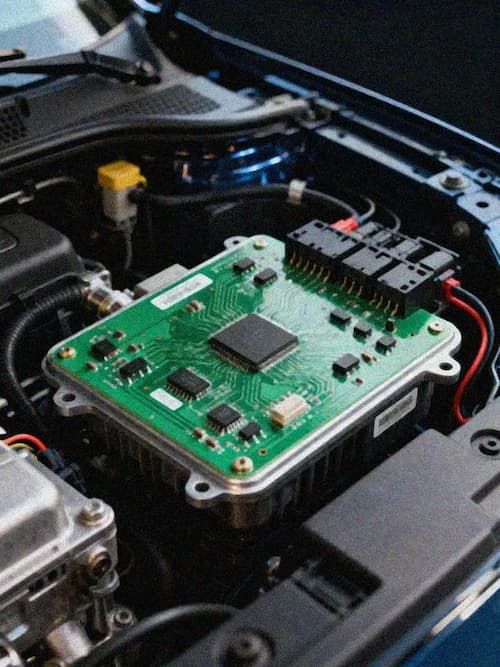
- Autonomous vehicle edge computing security units: Meet high-speed data transmission, wide temperature adaptability, and anti-vibration requirements for in-vehicle edge security processing modules that handle vehicle driving data and user privacy information.
Key Advantages
- Security-First Design Methodology: Integrates security requirements at every stage of the design process, from stack planning to routing optimization, avoiding post-design security patching that reduces product performance and reliability. Security features are embedded into the board architecture rather than added as external modules, reducing attack surfaces.
- Balanced Performance and Cost: Optimizes design schemes based on deployment scenarios, selecting appropriate substrate materials, layer counts, and manufacturing processes to meet security and performance requirements while controlling overall production costs. Supports both small-batch prototype verification and large-scale mass production design adjustments.
- Scalable Design Support: Offers modular design configurations that can be adapted to different edge computing security hardware specifications, supporting rapid iteration from prototype verification to large-scale mass production. Design files are fully compatible with standard manufacturing processes worldwide, reducing production transfer risks.
- Cross-Industry Adaptability: Has been validated across multiple vertical industries including industrial control, telecommunications, smart city, and transportation, with proven reliability in diverse edge deployment environments. Design teams have deep expertise in industry-specific security requirements, reducing the risk of non-compliance.
- Full-Process Technical Support: Provides end-to-end design support from schematic review, layout optimization, prototyping guidance to mass production troubleshooting, reducing development cycles and lowering project risks. Customized design workshops are also available for teams with unique edge security requirements.
Contact Information
If you have edge computing security PCB design requirements for your project, you can reach out to the technical support team to discuss your specific needs. The team provides free technical evaluation services, customized design scheme drafting, and professional consulting support to help you deliver secure, high-performance edge computing hardware products on schedule.